

September 25, 2024
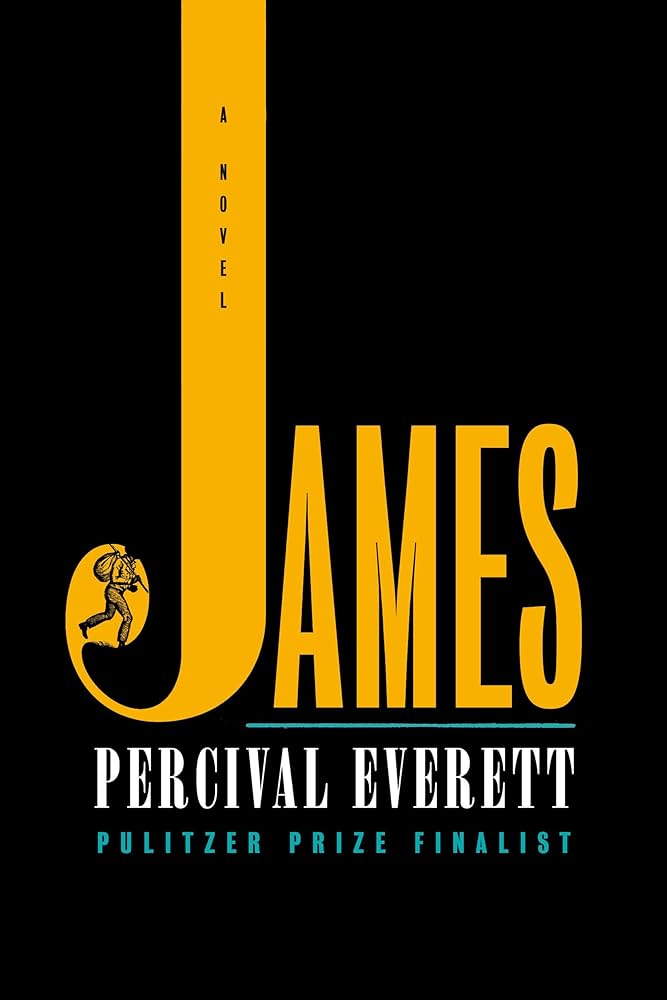
I have to write this review, even though it hurts. James was one of my most anticipated releases of 2024. You guys know I typically don't anticipate books at all. But this year both Danez Smith and Rémy Ngamije are blessing us with new books, so I actually took some time to look into other books that would be published this year. This is how I came to hear of James. Everyone and their mamma was raving about this new Huckleberry Finn retelling, how funny it is, how clever, how perfect. This book has an 4.65 (!!!!) average rating on Goodreads. In reviews, people act like Percival Everett is the second incarnation of Christ himself. To say that I was HYPED for this book is an understatement. I was so ready to love it!
Sure, I had some questions as to why Huckleberry Finn was chosen in the first place, as it's quite the progressive text, and despite its flaws, Jim is a well-fleshed out character, but I love seeing Black people thrive so I was more than willing to go on this ride. Turns out all of ya'll are liars, and this is actually not only one of the worst books I've ever read, it's also one of the most useless retellings. Jean Rhys is turning in her grave because she does not want to witness this. Anyways, to bring some order into this chaos, I actually decided to split this review into different sections and talk about what I liked (not much, welp) and what I didn't (brace yo'self).
Writing style
Let's start light because writing style is always hella subjective BUT I reaaaally didn't vibe with Everett's writing style. It is sooo straight-forward and simple, I cannot deal with it. James is a 300-page novel and I'm convinced I read it within 4-5 hours, and I am a very slow reader. It went by so quick??? And that's because 80% of this novel is dialogue. Everett doesn't know what descriptions are. You can flip to any random page and all you will see is dialogue. And I know some of you will actually like the book for it – and I respect that – but I want more pomp, more introspection, more landscape... just MORE.
I also really didn't think that this was funny. Sure, I laughed maybe 3 times, but overall, this is not written with aaaany humor. "The correct incorrect grammar" did nothing for me, Huck being unable to understand Jim when he spoke standard English did nothing for me... it really wasn't giving. They have this one stupid exchange: Huck: "Why are you talking like that?" Jim: "Are you referring to my diction or my content?" And I really just hate it, because NO ONE is talking like that. It's so over the top and silly.
And it's really such a shame because I LOVE the first sentence of this novel: "Those little bastards were hiding out there in the tall grass." It's sooo good, and could've set the tone for an essential piece of rewriting... alas!
Characterisation
Whew, chile. This is the big one. The reason why I was interested in this retelling that James is supposed to be, is to get more insight into the characters we already know from Twain's novel; mainly, of course, James. The TITULAR character. Who is this man? What motivates him? What are his fears, his desires, his struggles? Why is he the way that he is? Percival Everett never manages to make him come off the page. At the end of this book I'm none the wiser. I don't know who this man is. At the beginning of the book (p. 35) there's this beautiful quote:
"I was as much scared as angry, but where does a slave put anger? We could be angry with one another; we were human. But the real source of our rage had to go without address, swallowed, repressed. They were going to rip my family apart and send me to New Orleans, where I would be even farther from freedom and would probably never see my family again."
Unfortunately, this is one of the only moments of introspection we get in this whole 300-page long novel. Everett never makes us feel Jim's fears or his anger. It's a damn shame. I didn't really care what was happening to him, and that's a feat in and of itself, because terrible fucking things were happening to him... I wasn't able to connect to any other characters either, welp.
What Everett does to his female characters is truly mind-boggling. None of them are well fleshed out. All (!) of them are used as devices to fuel Jim's story along. I'm truly baffled that very few reviewers seem to have a problem with that. Let's start with Jim's wife Sadie and his daughter Elizabeth. We as readers never get to know them. All we're supposed to know about them is that Jim loves them and wants to reunite with them. They are simply used as a motivation for Jim to run away and his desire to free them. We never explore their relationship and bond. Especially with a reveal that comes later in the book (I'll talk about it in the last section of this review due to spoilers), I felt like we really needed to explore his marriage better... because WTF? What did Sadie say to all of this? When and how did she and Jim get together?
But most appalling are Everett's use of Sammy and Katie. Sammy is a young Black woman that Jim and Norman free during one of their stops. Sammy reveals to them that she was repeatedly raped by her white overseer since she was a child. Something that is just so so horrible and it actually made me close the book for a second because I really struggle with reading about such heavy topics. But instead of giving Sammy's characters any purpose, Everett has her shot 10 pages later during their flight, only for Jim and Norman to have a conversation about freedom, with Jim spewing the bullshit that at least now she "died free". Excuse me? That death is the best she could've hoped for? Fuck that!
I felt a similar rage when Everett introduces the character of Katie, only for Jim to witness her being raped by the white overseer Mister Hopkins. That made me so damn mad. First of all, why did you have to describe her rape in detail on the page?? Just exploitative and unnecessary. And why don't you give this woman any thoughts, any story beyond this? I kid you not, she is simply introduced to be raped, so that Jim can muster up the courage/find the rage to murder Hopkins afterwards. It is so uncomfortable.
Plot/Narrative devices
The plot was pretty cheap with Jim going from A to B to C, always encountering shitty people along the way, but I guess the original wasn't much more original in that regard either. So whilst the plot wasn't engaging for me, the thing that really didn't work for me were the narrative devices that Everett was using. I just didn't like them. I didn't like Jim's dream-conversations with the philosophers. I get they were there to show the hypocrisy in philosophical thought but they were NOT funny, and there were decidedly too many of them. I didn't like that the big reveal (of how Jim and Huck are linked) came so late in the book, it should've been revealed way earlier in order for Everett to explore it further. I also really didn't like the pacing and felt like the truly exciting stuff happened during the last 20 pages when Jim finally got to the plantation where his wife and daughter were enslaved. I really liked that bit.
Purpose/Intention
I'm just really confused by Everett's intention. What was the purpose of writing this novel? Parts of it are supposed to be realistic (historical fiction) but then there are other parts that are so fucking unrealistic, but Everett never truly leans into magical realism/fantasy. I feel like he truly missed the mark. In regards to the ending, I love that Jim became an avenger, or how he said it: "I am the angel of death, come to offer sweet justice in the night. I am a sign. I am your future. I am James."
I'm sure it's not just me but I find novels/fiction set during the time of enslavement to be really hard to stomach. I can watch documentaries all the time and am willing to learn and educate myself, but fiction can quickly feel exploitative. That's why I love authors who are willing to take a risk and shake things up a bit. A perfect example would be Wayétu Moore's She Would Be King. The novel reimagines the foundation of Liberia, but instead of solely focusing on the horrors and the plight of Black people, Wayétu gives some of her Black characters special powers, like superhuman strength or invisibility, which empowers them (and the reader), and makes reading the story bearable and triumphant. Everett tries the same with the ending, with pistol-swinging James freeing all the slaves from the plantation, and I loved that bit (as unrealistic as it was, that's the kinda shit I wanna see!!!), but it feels lacklustre because the rest of the story is not that. It almost comes out of nowhere.
In terms of purpose, I also feel like James adds almost nothing of substance to Twain's Huckleberry Finn. The only thing (SPOILER INCOMING) is the reveal that Huck is Jim's son. There are parts of that that I like (first and foremost, it explains why this Black enslaved man takes so many risks/sacrifices so much for this random "white" boy in Twain's novel) but there are more parts that I don't like (Why wasn't colorism explored then? Why did we never get a look at Jim's relationship to Huck's mom? WHO WAS THIS WOMAN? I desperately need to know, but Everett never answers these questions...). It was just really poorly done.
You guys know how much I love books written in the literary tradition of writing back. Jean Rhys' Wide Sargasso Sea and Daoud's Meursault, contre-enquête add so much to their source materials (Jane Eyre and L'Étranger respectively). They take characters that are on the fringes of these narratives and finally give them a voice. I don't feel like Everett's James is much louder than Twain's Jim, or more human than him. Not that much was added to his character. Reading this actually has me convinced that we need a feminist retelling for Huck's mom. Ahhhh.
Anyways, I ordered another retelling last week – The Silence of the Girls – let's hope it's better than this.
Sure, I had some questions as to why Huckleberry Finn was chosen in the first place, as it's quite the progressive text, and despite its flaws, Jim is a well-fleshed out character, but I love seeing Black people thrive so I was more than willing to go on this ride. Turns out all of ya'll are liars, and this is actually not only one of the worst books I've ever read, it's also one of the most useless retellings. Jean Rhys is turning in her grave because she does not want to witness this. Anyways, to bring some order into this chaos, I actually decided to split this review into different sections and talk about what I liked (not much, welp) and what I didn't (brace yo'self).
Writing style
Let's start light because writing style is always hella subjective BUT I reaaaally didn't vibe with Everett's writing style. It is sooo straight-forward and simple, I cannot deal with it. James is a 300-page novel and I'm convinced I read it within 4-5 hours, and I am a very slow reader. It went by so quick??? And that's because 80% of this novel is dialogue. Everett doesn't know what descriptions are. You can flip to any random page and all you will see is dialogue. And I know some of you will actually like the book for it – and I respect that – but I want more pomp, more introspection, more landscape... just MORE.
I also really didn't think that this was funny. Sure, I laughed maybe 3 times, but overall, this is not written with aaaany humor. "The correct incorrect grammar" did nothing for me, Huck being unable to understand Jim when he spoke standard English did nothing for me... it really wasn't giving. They have this one stupid exchange: Huck: "Why are you talking like that?" Jim: "Are you referring to my diction or my content?" And I really just hate it, because NO ONE is talking like that. It's so over the top and silly.
And it's really such a shame because I LOVE the first sentence of this novel: "Those little bastards were hiding out there in the tall grass." It's sooo good, and could've set the tone for an essential piece of rewriting... alas!
Characterisation
Whew, chile. This is the big one. The reason why I was interested in this retelling that James is supposed to be, is to get more insight into the characters we already know from Twain's novel; mainly, of course, James. The TITULAR character. Who is this man? What motivates him? What are his fears, his desires, his struggles? Why is he the way that he is? Percival Everett never manages to make him come off the page. At the end of this book I'm none the wiser. I don't know who this man is. At the beginning of the book (p. 35) there's this beautiful quote:
"I was as much scared as angry, but where does a slave put anger? We could be angry with one another; we were human. But the real source of our rage had to go without address, swallowed, repressed. They were going to rip my family apart and send me to New Orleans, where I would be even farther from freedom and would probably never see my family again."
Unfortunately, this is one of the only moments of introspection we get in this whole 300-page long novel. Everett never makes us feel Jim's fears or his anger. It's a damn shame. I didn't really care what was happening to him, and that's a feat in and of itself, because terrible fucking things were happening to him... I wasn't able to connect to any other characters either, welp.
What Everett does to his female characters is truly mind-boggling. None of them are well fleshed out. All (!) of them are used as devices to fuel Jim's story along. I'm truly baffled that very few reviewers seem to have a problem with that. Let's start with Jim's wife Sadie and his daughter Elizabeth. We as readers never get to know them. All we're supposed to know about them is that Jim loves them and wants to reunite with them. They are simply used as a motivation for Jim to run away and his desire to free them. We never explore their relationship and bond. Especially with a reveal that comes later in the book (I'll talk about it in the last section of this review due to spoilers), I felt like we really needed to explore his marriage better... because WTF? What did Sadie say to all of this? When and how did she and Jim get together?
But most appalling are Everett's use of Sammy and Katie. Sammy is a young Black woman that Jim and Norman free during one of their stops. Sammy reveals to them that she was repeatedly raped by her white overseer since she was a child. Something that is just so so horrible and it actually made me close the book for a second because I really struggle with reading about such heavy topics. But instead of giving Sammy's characters any purpose, Everett has her shot 10 pages later during their flight, only for Jim and Norman to have a conversation about freedom, with Jim spewing the bullshit that at least now she "died free". Excuse me? That death is the best she could've hoped for? Fuck that!
I felt a similar rage when Everett introduces the character of Katie, only for Jim to witness her being raped by the white overseer Mister Hopkins. That made me so damn mad. First of all, why did you have to describe her rape in detail on the page?? Just exploitative and unnecessary. And why don't you give this woman any thoughts, any story beyond this? I kid you not, she is simply introduced to be raped, so that Jim can muster up the courage/find the rage to murder Hopkins afterwards. It is so uncomfortable.
Plot/Narrative devices
The plot was pretty cheap with Jim going from A to B to C, always encountering shitty people along the way, but I guess the original wasn't much more original in that regard either. So whilst the plot wasn't engaging for me, the thing that really didn't work for me were the narrative devices that Everett was using. I just didn't like them. I didn't like Jim's dream-conversations with the philosophers. I get they were there to show the hypocrisy in philosophical thought but they were NOT funny, and there were decidedly too many of them. I didn't like that the big reveal (of how Jim and Huck are linked) came so late in the book, it should've been revealed way earlier in order for Everett to explore it further. I also really didn't like the pacing and felt like the truly exciting stuff happened during the last 20 pages when Jim finally got to the plantation where his wife and daughter were enslaved. I really liked that bit.
Purpose/Intention
I'm just really confused by Everett's intention. What was the purpose of writing this novel? Parts of it are supposed to be realistic (historical fiction) but then there are other parts that are so fucking unrealistic, but Everett never truly leans into magical realism/fantasy. I feel like he truly missed the mark. In regards to the ending, I love that Jim became an avenger, or how he said it: "I am the angel of death, come to offer sweet justice in the night. I am a sign. I am your future. I am James."
I'm sure it's not just me but I find novels/fiction set during the time of enslavement to be really hard to stomach. I can watch documentaries all the time and am willing to learn and educate myself, but fiction can quickly feel exploitative. That's why I love authors who are willing to take a risk and shake things up a bit. A perfect example would be Wayétu Moore's She Would Be King. The novel reimagines the foundation of Liberia, but instead of solely focusing on the horrors and the plight of Black people, Wayétu gives some of her Black characters special powers, like superhuman strength or invisibility, which empowers them (and the reader), and makes reading the story bearable and triumphant. Everett tries the same with the ending, with pistol-swinging James freeing all the slaves from the plantation, and I loved that bit (as unrealistic as it was, that's the kinda shit I wanna see!!!), but it feels lacklustre because the rest of the story is not that. It almost comes out of nowhere.
In terms of purpose, I also feel like James adds almost nothing of substance to Twain's Huckleberry Finn. The only thing (SPOILER INCOMING) is the reveal that Huck is Jim's son. There are parts of that that I like (first and foremost, it explains why this Black enslaved man takes so many risks/sacrifices so much for this random "white" boy in Twain's novel) but there are more parts that I don't like (Why wasn't colorism explored then? Why did we never get a look at Jim's relationship to Huck's mom? WHO WAS THIS WOMAN? I desperately need to know, but Everett never answers these questions...). It was just really poorly done.
You guys know how much I love books written in the literary tradition of writing back. Jean Rhys' Wide Sargasso Sea and Daoud's Meursault, contre-enquête add so much to their source materials (Jane Eyre and L'Étranger respectively). They take characters that are on the fringes of these narratives and finally give them a voice. I don't feel like Everett's James is much louder than Twain's Jim, or more human than him. Not that much was added to his character. Reading this actually has me convinced that we need a feminist retelling for Huck's mom. Ahhhh.
Anyways, I ordered another retelling last week – The Silence of the Girls – let's hope it's better than this.


![Profile Image for s.penkevich [hiatus-will return-miss you all].](https://www.goodreads.com/_next/image?url=https%3A%2F%2Fi.gr-assets.com%2Fimages%2FS%2Fcompressed.photo.goodreads.com%2Fusers%2F1735525095i%2F6431467._UX200_CR0%2C11%2C200%2C200_.jpg&w=128&q=75)


